



Tsar BombaTsar Bomba (Russian: Царь-бомба, literally "Tsar-bomb") is the Western name for the largest, most powerful nuclear weapon ever detonated. Developed by the Soviet Union, the bomb of about 50 megatons was codenamed Ivan by its developers.

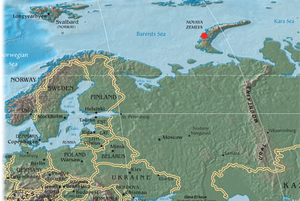
The bomb was tested on October 30, 1961, in Novaya Zemlya, an island in the Arctic Sea. The device was scaled down from its original design of 100 megatons to reduce the resulting nuclear fallout.
A Tsar Bomba-type casing on display at Chelyabinsk-70OriginsSoviet Premier Nikita Khrushchev initiated the project on July 10, 1961, requesting that the test take place in late October, while the 22nd Congress of the CPSU was in session.
The term "Tsar Bomba" harkens to the historical Russian practice of building impractically large things as shows of power or prowess, such as the massive bell (Tsar Kolokol); the world's largest cannon (Tsar Pushka); and the unwieldy Tsar Tank. Although the bomb was so named by Western sources (the strictly anti-monarchist Soviet Union would not have named this symbol of national pride in honor of its past rulers), the name is now widely used in Russia.
Codenamed "Ivan" during its development, the Tsar Bomba was not intended for use in warfare but was an instance of the Cold War-era sabre-rattling indulged in by the USSR and the U.S. Khrushchev gave the go-ahead at a time of grave tension: the first Berlin wall was erected one month later in August 1961. Moreover, with France recently emerging as the second European nuclear force (Gerboise Bleue) with the United Kingdom. The USSR had ended a de facto moratorium on nuclear tests (which lasted for nearly three years) and was about to deploy nuclear weapons in Cuba, which led to the Cuban Missile Crisis.
In a speech to the United Nations General Assembly about the test, Khrushchev used the Russian idiom "show somebody Kuzka's mother", which means "to punish". Because of this, sometimes the weapon is referred to as "Kuzka's mother" (Кузькина мать) in Russian sources.
Site of the detonation.
The Tsar Bomba was too large to fit entirely within the bomb bay of the Tupolev Tu-95, the largest Soviet bomber of the day.DesignThe Tsar Bomba was a multi-stage hydrogen bomb with a yield of about 50 megatons (Mt).[1] The initial three-stage (fission-fusion-fission) design was capable of approximately 100 Mt, but at a cost of too much radioactive fallout. To limit fallout, the third stage, consisting of a uranium-238 fission tamper (which greatly amplifies the reaction by fissioning uranium atoms with fast neutrons from the fusion reaction), was replaced with one made of lead. This eliminated fast fission by the fusion-stage neutrons, so that approximately 97% of the total energy resulted from the fusion stage alone (as such, it was one of the "cleanest" nuclear bombs ever created, generating a very low amount of fallout relative to its yield). There was a strong incentive for this modification since most of the fallout from a test of the bomb would fall on populated Soviet territory.
The components were designed by a team of physicists, headed by Academician Julii Borisovich Khariton, which included Andrei Sakharov, Victor Adamsky, Yuri Babayev, Yuri Smirnov, and Yuri Trutnev. Shortly after the Tsar Bomba was detonated, Sakharov began speaking out against nuclear weapons, which culminated in his becoming a full-blown dissident.
A view of the Tsar Bomba mushroom cloud.The Tsar Bomba was flown to its test site by a specially modified Tu-95 release plane which took off from an airfield in the Kola peninsula, flown by Major Andrei E. Durnotsev. The release plane was accompanied by a Tu-16 observer plane which took air samples and filmed the test. Both aircraft were painted with a special reflective white paint to limit heat damage.
The bomb, weighing 27 tonnes, was so large (8 meters long by 2 m in diameter) that the Tu-95 had to have its bomb bay doors and wing fuel tanks removed. The bomb was attached to an 800 kilogram fall retardation parachute, which gave the release and observer planes time to fly about 45 km from ground zero. Failing such retardation, the bomb would have either reached its planned detonation altitude so fast it would have turned the test into a suicide mission, or it would have crashed into the ground at high speed with unpredictable results. The U.S. has fitted a few of its nuclear bombs with parachute retardation for the same reason.
The Tsar Bomba detonated at 11:32 a.m., located approximately at 73.85° N 54.50° E [2], over the Mityushikha Bay nuclear testing range (Sukhoy Nos Zone C), north of the Arctic Circle on Novaya Zemlya Island in the Arctic Sea. The bomb was dropped from an altitude of 10,500 m; it was designed to detonate at a height of 4,000 m over the land surface (4,200 m over sea level) by barometric sensors.
The original U.S. estimate of the yield was 57 Mt, but since 1991 all Russian sources have stated its yield as 50 Mt. Nonetheless, Khrushchev warned in a filmed speech to the Communist parliament of the existence of a 100 Mt bomb (technically the design was capable of this yield). The fireball touched the ground, reached nearly as high as the altitude of the release plane, and was seen 1,000 km away. The heat could have caused third degree burns at a distance of 100 km. The subsequent mushroom cloud was about 60 km high and 30–40 km wide. The explosion could be seen and felt in Finland, even breaking windows there. Atmospheric focusing caused blast damage up to 1,000 km away. The seismic shock created by the detonation was measurable even on its third passage around the earth.
Since 50 Mt is 2.1×10¹⁷ joules, the average power produced during the entire fission-fusion process, lasting around 39 nanoseconds, was a power of about 5.3×1024 watts or 5.3 yottawatts. This is equivalent to approximately 1% of the power output of the Sun. The detonation of Tsar Bomba therefore qualifies as being the single most powerful device ever utilized throughout the history of humanity. By contrast, the largest weapon ever produced by the United States, the now-decommissioned B41, had a predicted maximum yield of 25 Mt, and the largest nuclear device ever tested by the U.S. (Castle Bravo) yielded 15 Mt. Note the recent comparison with the asteroid impact which may have formed the Chicxulub Crater, an event larger by some six orders of magnitude.
AnalysisThe weight and size of the Tsar Bomba limited the range and speed of the specially modified bomber carrying it and ruled out its delivery by an ICBM (although on, December 24, 1962, a 50MT ICBM warhead developed by Chelyabinsk-70 was detonated at 24.2 megatons to reduce fallout [2]). Much of its high yield was—in terms of organic destruction—inefficiently radiated upwards into space. It has been estimated that detonating the original 100 Mt design would have released fallout amounting to about 25% of all fallout emitted since the invention of nuclear weapons. Hence the Tsar Bomba was an impractically powerful weapon. The Soviets decided that such a test blast would create too great a risk of nuclear fallout and a near certainty that the release plane would be unable to reach safety before detonation.[citation needed]
The Tsar Bomba was the culmination of a series of high-yield thermonuclear weapons designed by the USSR and U.S. during the 1950s (examples include the Mark-17[3] and B41). Such bombs were designed because:
* The nuclear bombs of the day were large and heavy, regardless of yield, and could only be delivered by strategic bombers. Hence yield was subject to dramatic economies of scale;
* It was feared that many bombers would fail to reach their targets because their size and low speed made detection and interception easy. Hence maximizing the firepower carried by any single bomber was vital;
* Prior to satellite intelligence, each side lacked precise knowledge of the location of the other side's military and industrial facilities;
* A bomb dropped without benefit of satellite navigation systems could easily miss its intended target by 5 km or more. Parachute retardation would only worsen this inaccuracy.
Thus certain bombs were designed to destroy an entire large city even if dropped 5–10 km from its centre. This objective meant that yield and effectiveness were positively correlated, at least up to a point. However, the advent of ICBMs accurate to 500 m or better, and especially the advent of satellite navigation, made such a design philosophy obsolete. Subsequent nuclear weapon design in the 1960s and 1970s focused primarily on increased accuracy, miniaturization, and safety. The standard practice for many years has been to employ multiple smaller warheads (MIRVs) to "carpet" an area. This is believed to result in greater ground damage.
Comparative fireball diameters for a selection of nuclear weapons, including the Tsar Bomba. Full blast effects extend many times beyond the fireball itself.Izvor:
Wikipedia